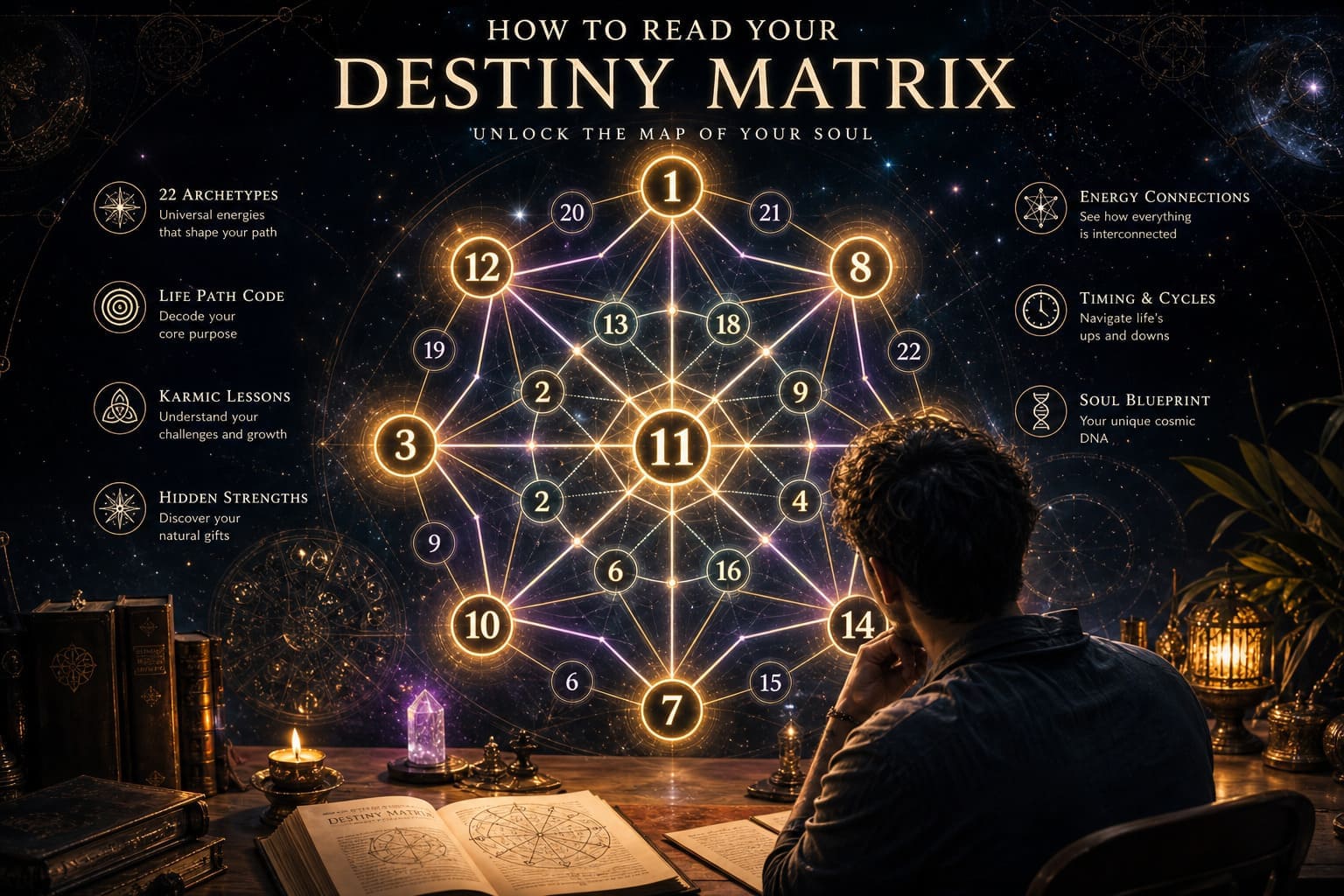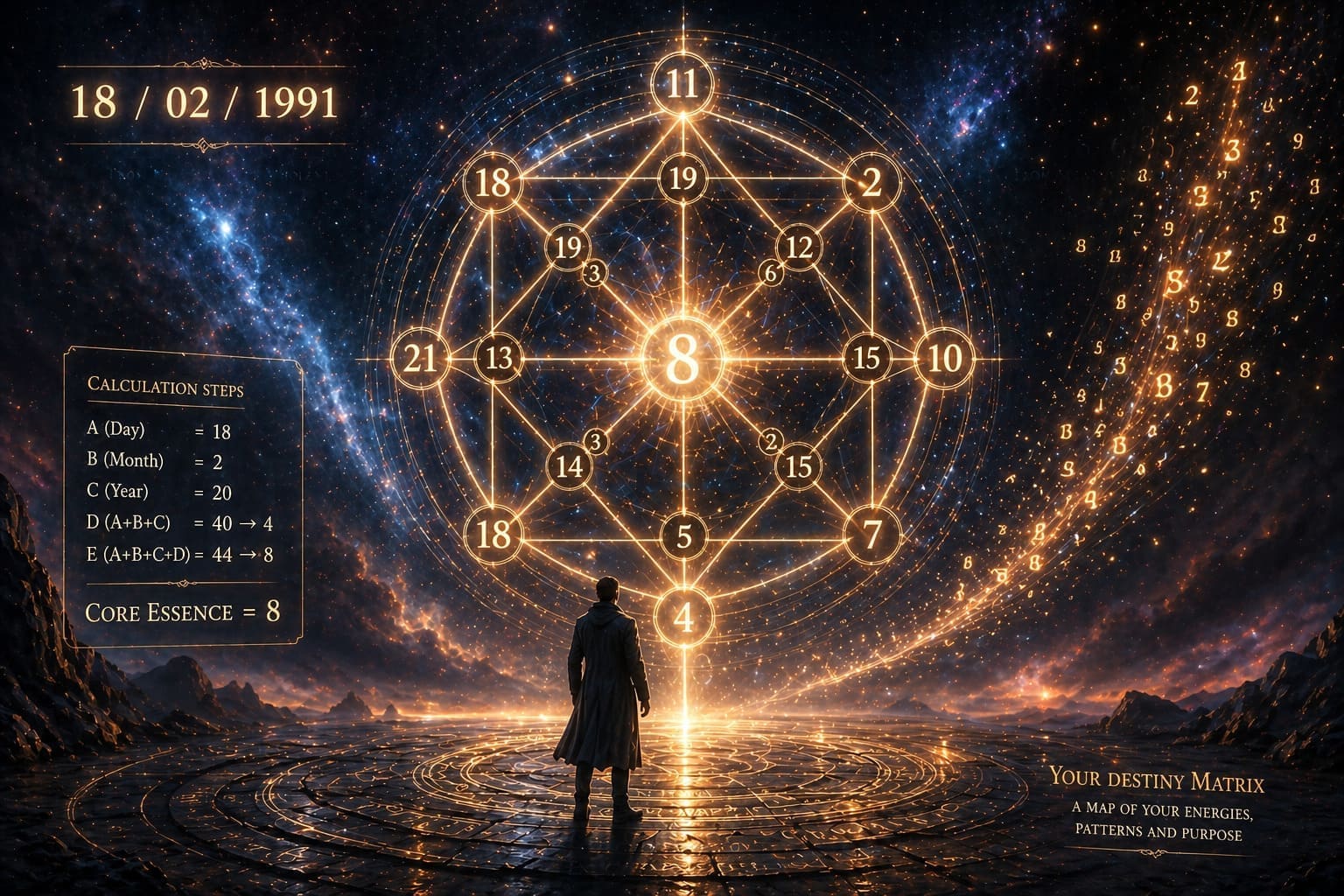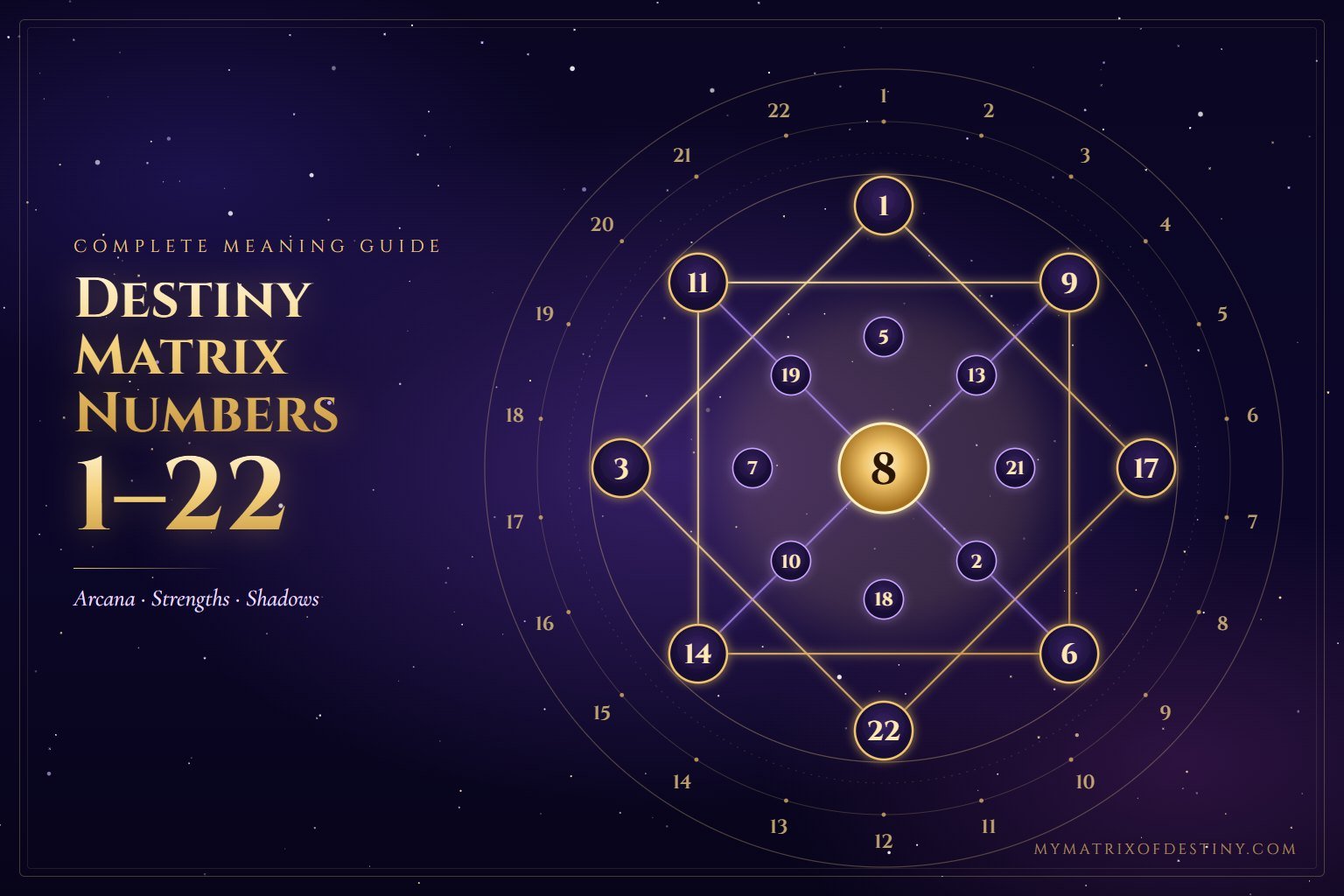
The Destiny Matrix is a symbolic system that uses 22 archetypal energies to explore different aspects of a person's character, experiences, relationships, talents, challenges, and personal development. Each energy is traditionally connected with one of the 22 Major Arcana of Tarot.
If you are learning how to read your Destiny Matrix chart, understanding the meaning behind each number is a good place to start. The same energy can express itself in different ways depending on where it appears, so a complete interpretation should consider both its strengths and its more challenging side.
In this guide, you will find the meanings of numbers 1 through 22, their associated Arcana, positive qualities, possible shadow expressions, and the broader life lessons they can represent.
Note: Different schools and websites may use slightly different names or numbering conventions for some Arcana. This guide follows the commonly used 1–22 framework and explains the symbolic themes rather than treating any interpretation as a fixed prediction.
Don’t have your numbers yet? Generate them with the free Destiny Matrix calculator and keep your chart open while you read.
What Is the Destiny Matrix?
The Matrix of Destiny is a birth-date-based esoteric system built around 22 archetypal energies. These energies are commonly associated with the Major Arcana and are used to explore recurring themes in a person's life.
Rather than describing a person with a single number, a complete chart contains several positions. Each position can represent a different area, such as personal characteristics, relationships, finances, talents, purpose, or karmic themes.
This is why two people who have the same number in their charts may not necessarily experience it in exactly the same way.
The system is generally used for self-reflection and symbolic interpretation, rather than as a scientifically validated method of predicting future events.
Why Are There 22 Energies?
The system is based on the idea of 22 major archetypal patterns, corresponding broadly with the Major Arcana of Tarot.
Each represents a different theme of human experience. Some are associated with beginnings and initiative, while others relate to intuition, relationships, transformation, responsibility, completion, or freedom.
The important point is that no single energy is inherently "good" or "bad."
For example, an energy associated with authority can appear as responsible leadership when expressed constructively. In a less balanced form, the same quality might become controlling behaviour.
This positive-and-shadow approach is important when interpreting a chart.
The 22 Numbers at a Glance
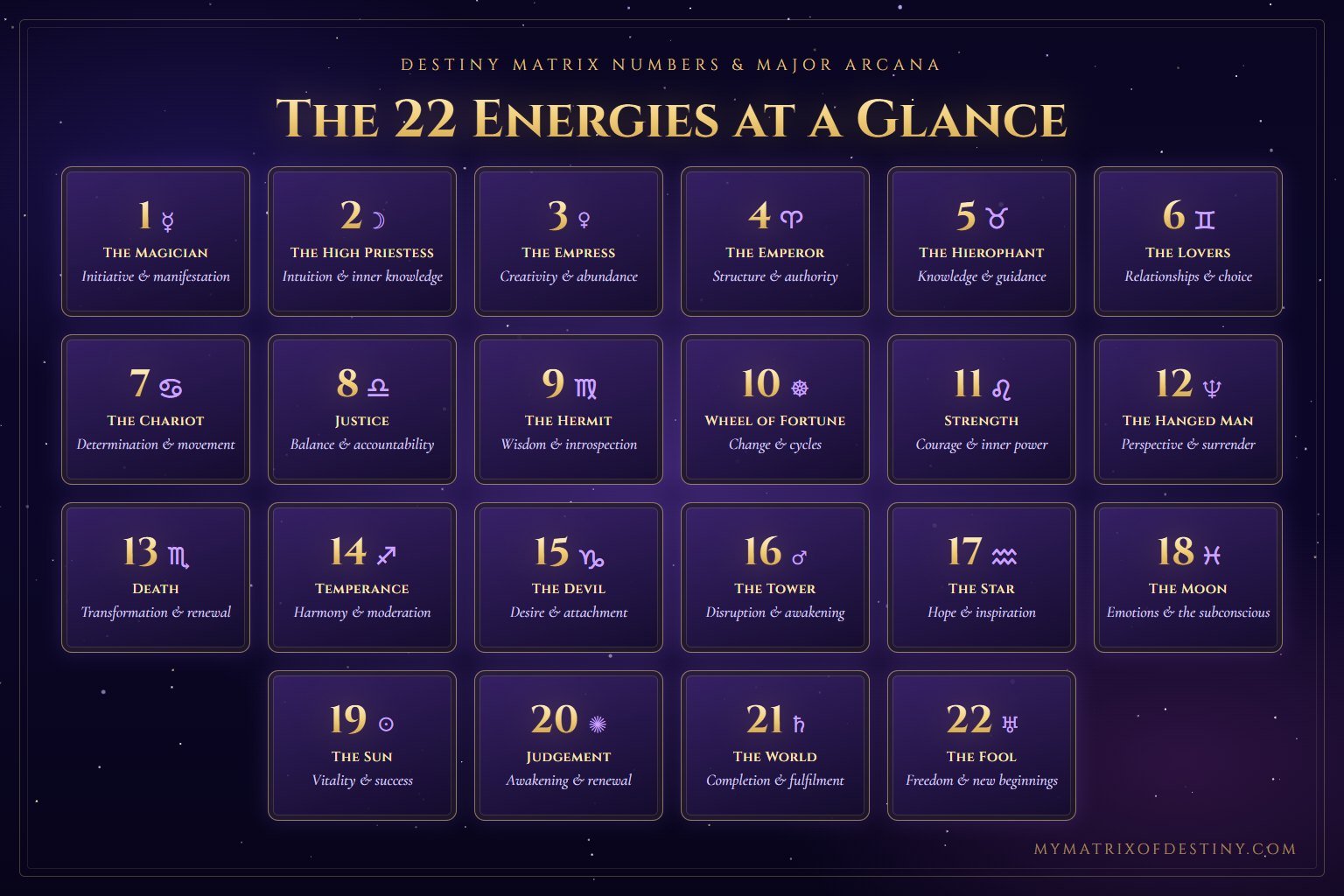
| Number | Arcana | Core Theme |
|---|---|---|
| 1 | The Magician | Initiative and manifestation |
| 2 | The High Priestess | Intuition and inner knowledge |
| 3 | The Empress | Creativity and abundance |
| 4 | The Emperor | Structure and authority |
| 5 | The Hierophant | Knowledge and guidance |
| 6 | The Lovers | Relationships and choice |
| 7 | The Chariot | Determination and movement |
| 8 | Justice | Balance and accountability |
| 9 | The Hermit | Wisdom and introspection |
| 10 | Wheel of Fortune | Change and cycles |
| 11 | Strength | Courage and inner power |
| 12 | The Hanged Man | Perspective and surrender |
| 13 | Death | Transformation and renewal |
| 14 | Temperance | Harmony and moderation |
| 15 | The Devil | Desire and attachment |
| 16 | The Tower | Disruption and awakening |
| 17 | The Star | Hope and inspiration |
| 18 | The Moon | Emotions and the subconscious |
| 19 | The Sun | Vitality and success |
| 20 | Judgement | Awakening and renewal |
| 21 | The World | Completion and fulfilment |
| 22 | The Fool | Freedom and new beginnings |
Want to know which of these energies is your personal arcana? Look it up from your birth date with the free arcana calculator.
Destiny Matrix Numbers 1–22 Explained
Number 1 — The Magician
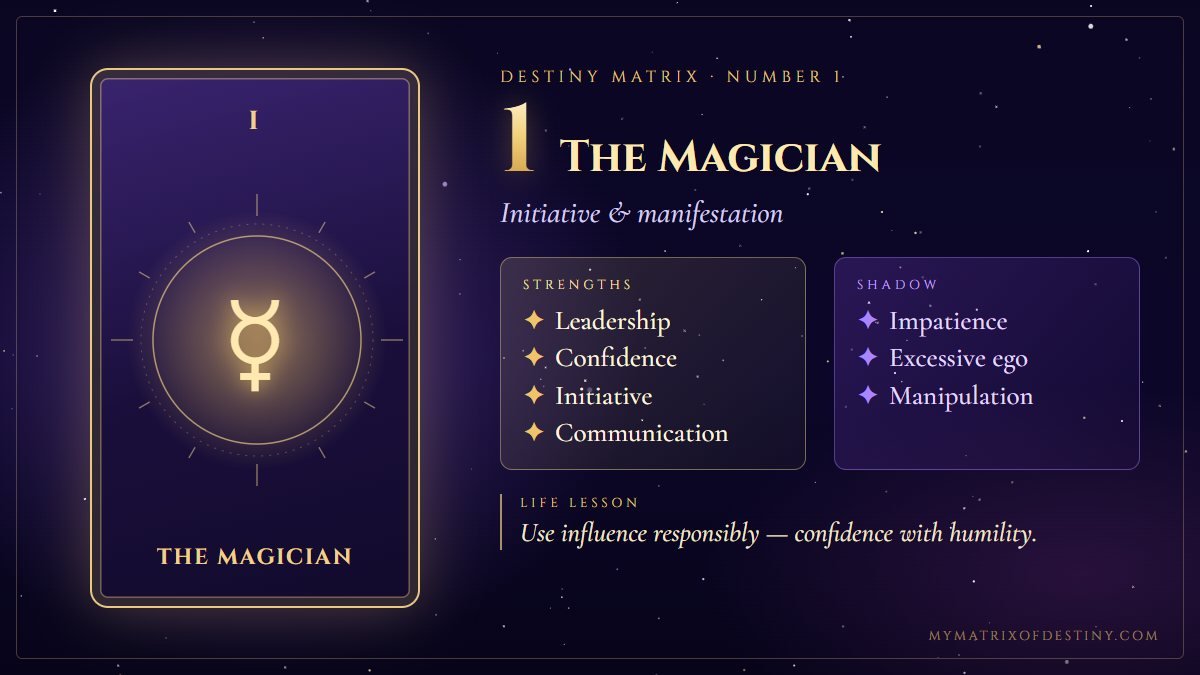
Core themes: initiative, willpower, creativity, communication, independence
The first energy is associated with The Magician, an archetype connected with personal ability and the power to turn an idea into action.
People influenced by this symbolism may be naturally proactive. They may prefer creating their own path rather than waiting for circumstances to change.
Strengths
This energy can express itself through:
- Leadership
- Confidence
- Initiative
- Creativity
- Communication
- Independence
- Entrepreneurship
- Problem-solving
Shadow expression
When poorly balanced, it may appear as impatience, excessive ego, manipulation, or an unwillingness to accept help from others.
Life lesson
The deeper lesson is learning how to use personal influence responsibly while combining confidence with humility.
Number 2 — The High Priestess
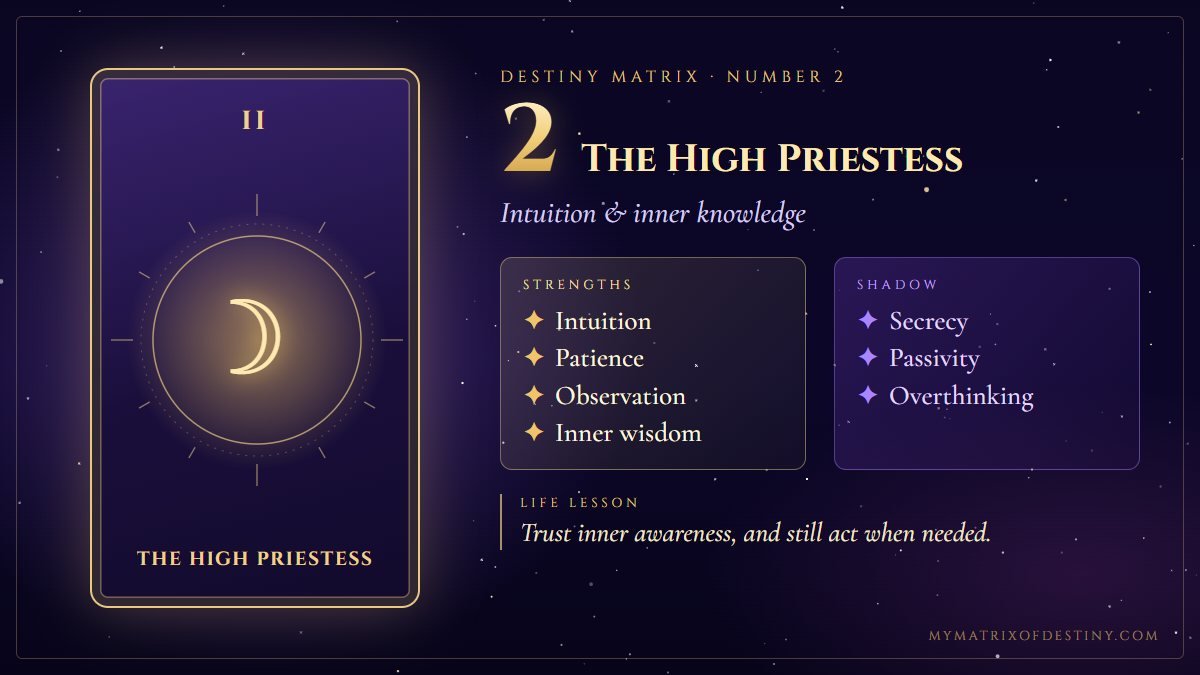
Core themes: intuition, sensitivity, inner wisdom, observation, mystery
The second energy corresponds with The High Priestess and represents the quieter side of awareness.
It is associated with intuition, observation, emotional sensitivity, and knowledge that is not always immediately visible.
Someone strongly influenced by this archetype may notice subtle details or understand situations through instinct before being able to explain them logically.
Strengths
- Intuition
- Patience
- Emotional awareness
- Observation
- Inner wisdom
- Sensitivity
- Reflection
Shadow expression
Its more difficult side can involve secrecy, passivity, excessive withdrawal, overthinking, or difficulty expressing emotions.
Life lesson
This energy encourages trust in inner awareness while maintaining enough practical judgment to act when necessary.
Number 3 — The Empress
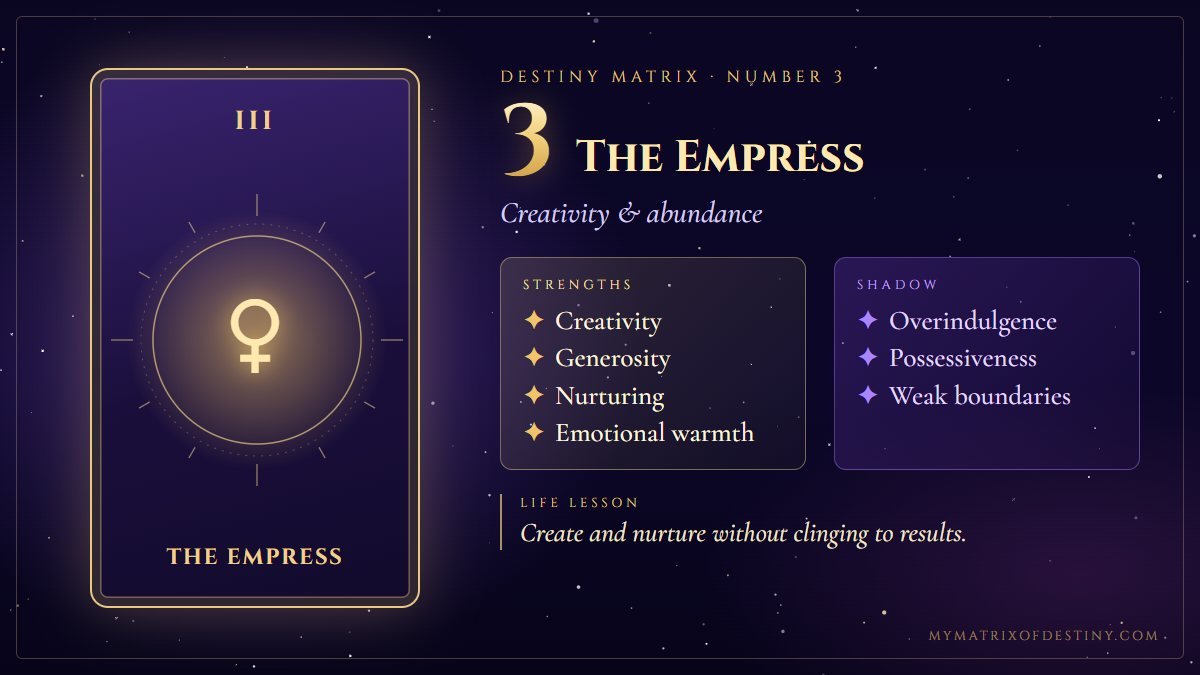
Core themes: creativity, nurturing, growth, beauty, abundance
The Empress represents creation and growth.
This energy can be expressed through artistic ability, nurturing relationships, appreciation of beauty, productive ideas, and the desire to help something or someone flourish.
Strengths
- Creativity
- Generosity
- Nurturing
- Artistic expression
- Emotional warmth
- Growth
- Appreciation of beauty
Shadow expression
An unbalanced expression may involve overindulgence, possessiveness, excessive comfort-seeking, or difficulty establishing boundaries.
Life lesson
The lesson is to create and nurture without becoming overly attached to the results.
Number 4 — The Emperor
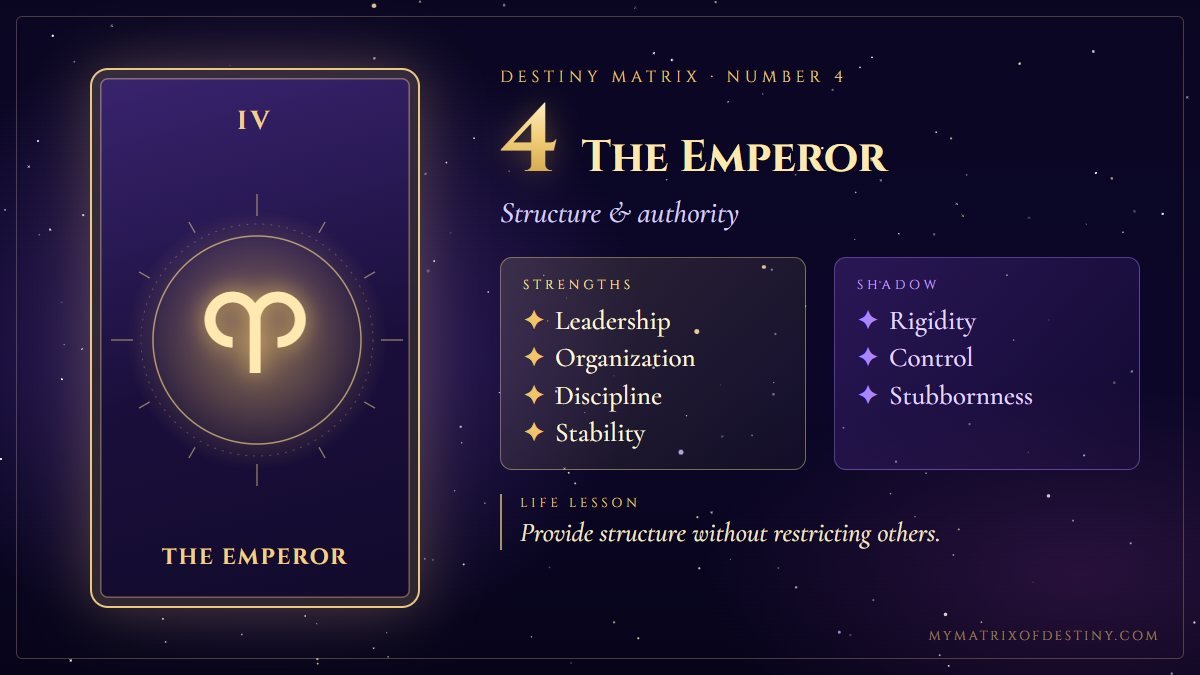
Core themes: structure, leadership, discipline, stability, responsibility
The Emperor represents order and authority.
This energy is often associated with people who like systems, organization, planning, responsibility, and clearly defined roles.
Strengths
- Leadership
- Organization
- Discipline
- Strategic thinking
- Stability
- Responsibility
- Decision-making
Shadow expression
Too much rigidity can turn healthy leadership into control. Other challenges may include stubbornness, authoritarian behaviour, and resistance to change.
Life lesson
The important balance is learning to provide structure without restricting everyone around you.
Number 5 — The Hierophant
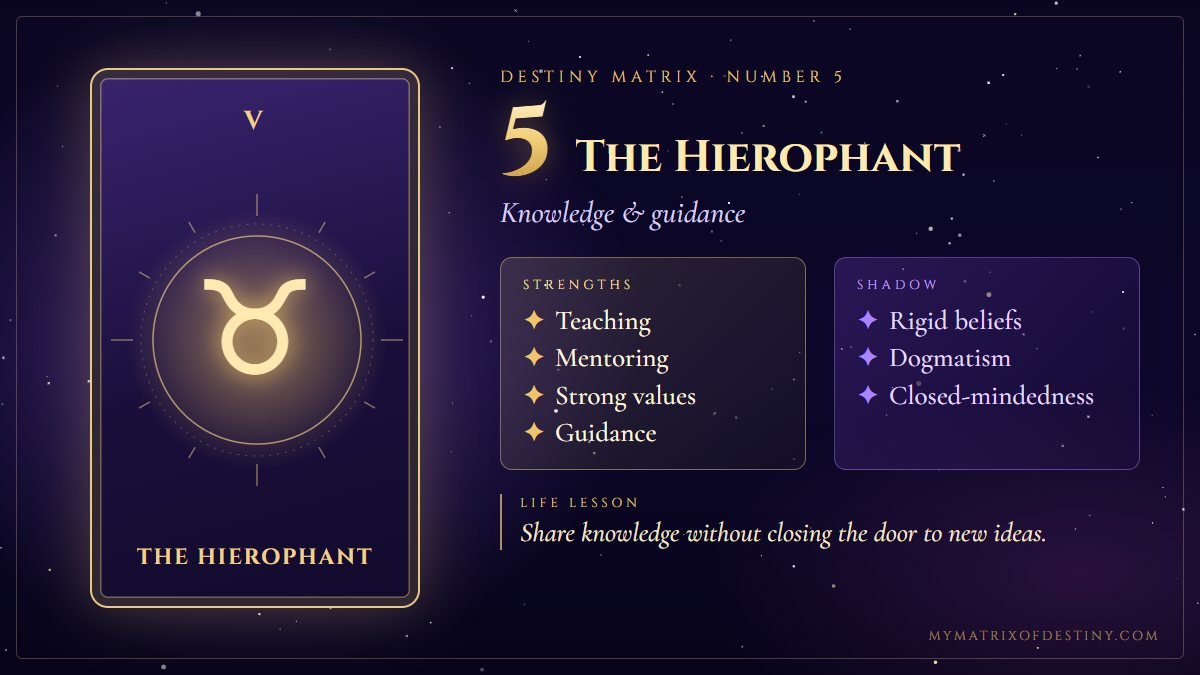
Core themes: knowledge, teaching, tradition, values, mentorship
The fifth energy is represented by The Hierophant, an archetype connected with learning, teaching, established knowledge, values, and guidance.
It can appear strongly in people who enjoy educating others or helping them understand complicated ideas.
Strengths
- Teaching
- Learning
- Mentoring
- Knowledge
- Guidance
- Strong values
- Intellectual development
Shadow expression
Its difficult side may involve rigid beliefs, dogmatism, resistance to new perspectives, or assuming that one method is correct for everyone.
Life lesson
Knowledge becomes more valuable when it is shared without closing the door to new ideas.
Number 6 — The Lovers
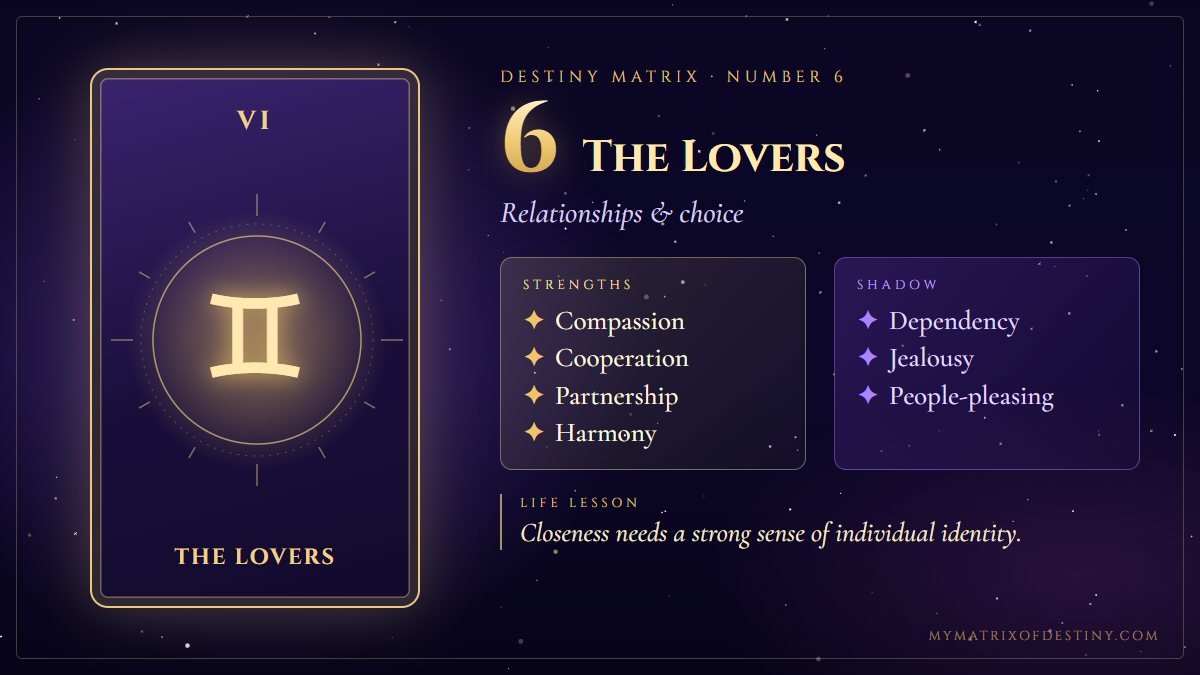
Core themes: love, partnership, harmony, attraction, choice
The sixth archetype is The Lovers.
It is strongly associated with relationships, emotional connection, cooperation, attraction, and important personal choices.
This energy is not only about romantic love. It can also relate to the choices we make when balancing our own needs with those of other people.
Strengths
- Compassion
- Cooperation
- Partnership
- Diplomacy
- Emotional connection
- Harmony
- Relationship-building
Shadow expression
Possible difficulties include dependency, jealousy, indecision, people-pleasing, and fear of being alone.
Life lesson
Healthy connection requires both closeness and a strong sense of individual identity.
Number 7 — The Chariot
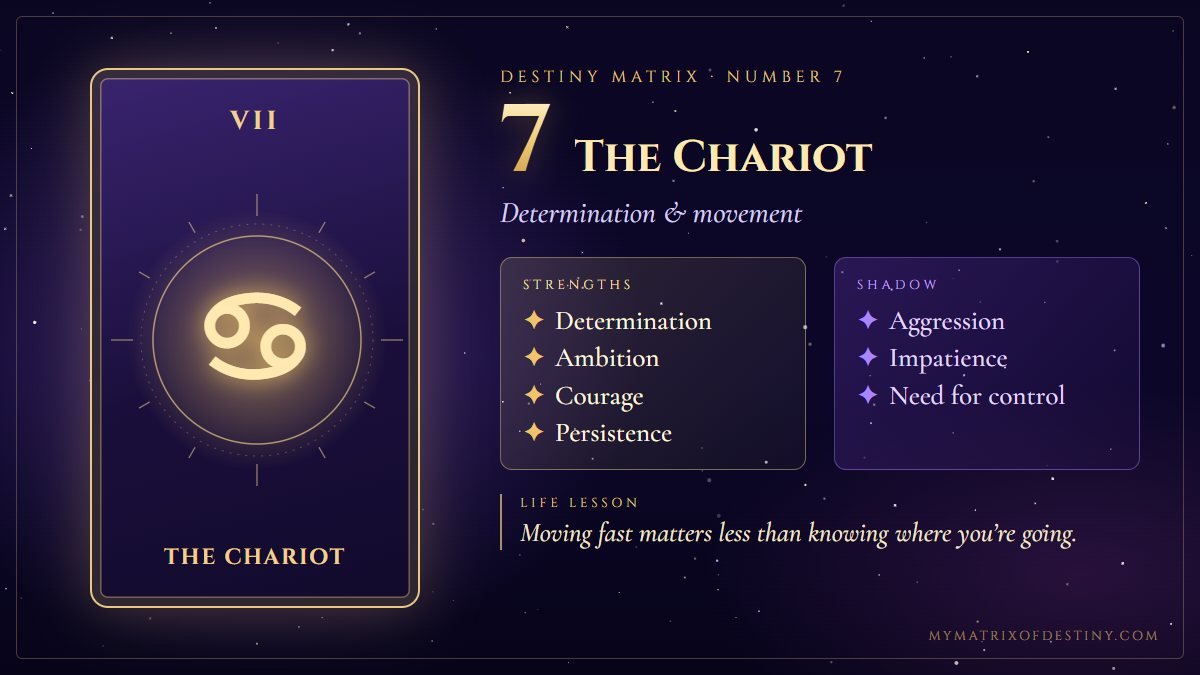
Core themes: ambition, determination, movement, achievement, control
The Chariot represents forward movement.
This energy is associated with people who are motivated to overcome obstacles and reach a specific destination.
Strengths
- Determination
- Ambition
- Motivation
- Courage
- Discipline
- Goal-setting
- Persistence
Shadow expression
When excessive, determination can become aggression, impatience, competitiveness, or a constant need to control circumstances.
Life lesson
Success is not simply about moving quickly. It also requires knowing where you are going.
Number 8 — Justice
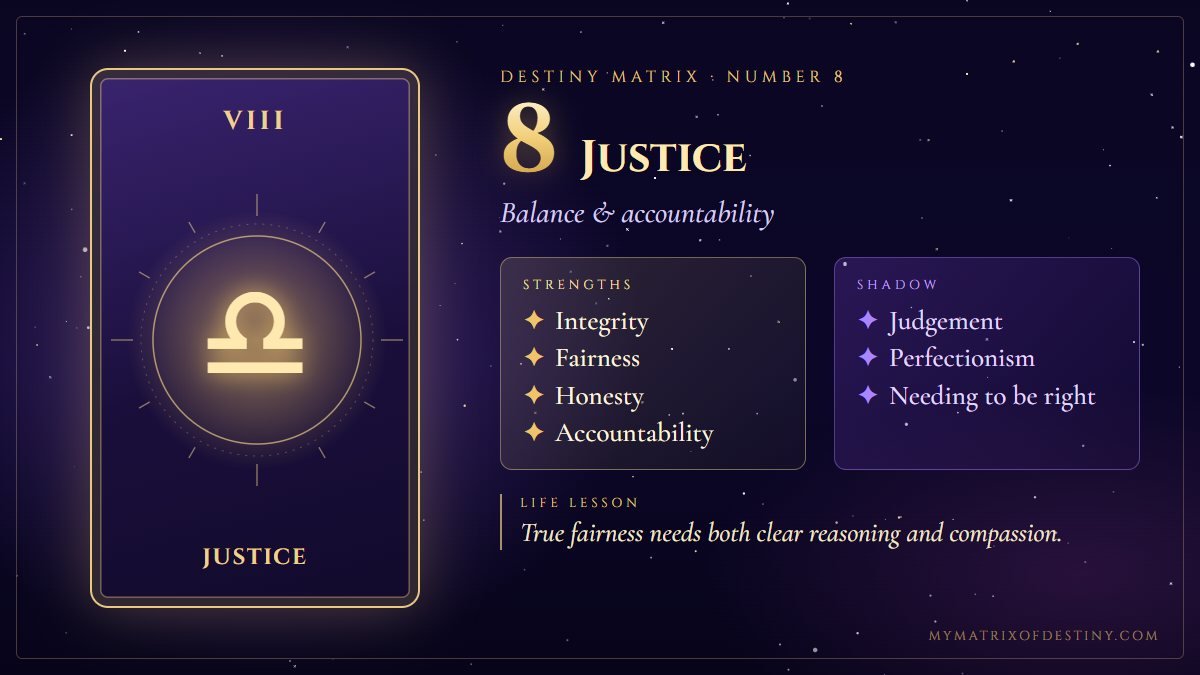
Core themes: balance, truth, fairness, accountability, responsibility
Justice is associated with balance and consequences.
This energy often draws attention to fairness, ethical decisions, responsibility, and the relationship between actions and their outcomes.
Strengths
- Integrity
- Fairness
- Honesty
- Accountability
- Logical thinking
- Responsibility
- Balanced decision-making
Shadow expression
An overly rigid expression can become judgemental, perfectionistic, unforgiving, or excessively focused on being right.
Life lesson
True fairness requires both clear reasoning and compassion.
Number 9 — The Hermit
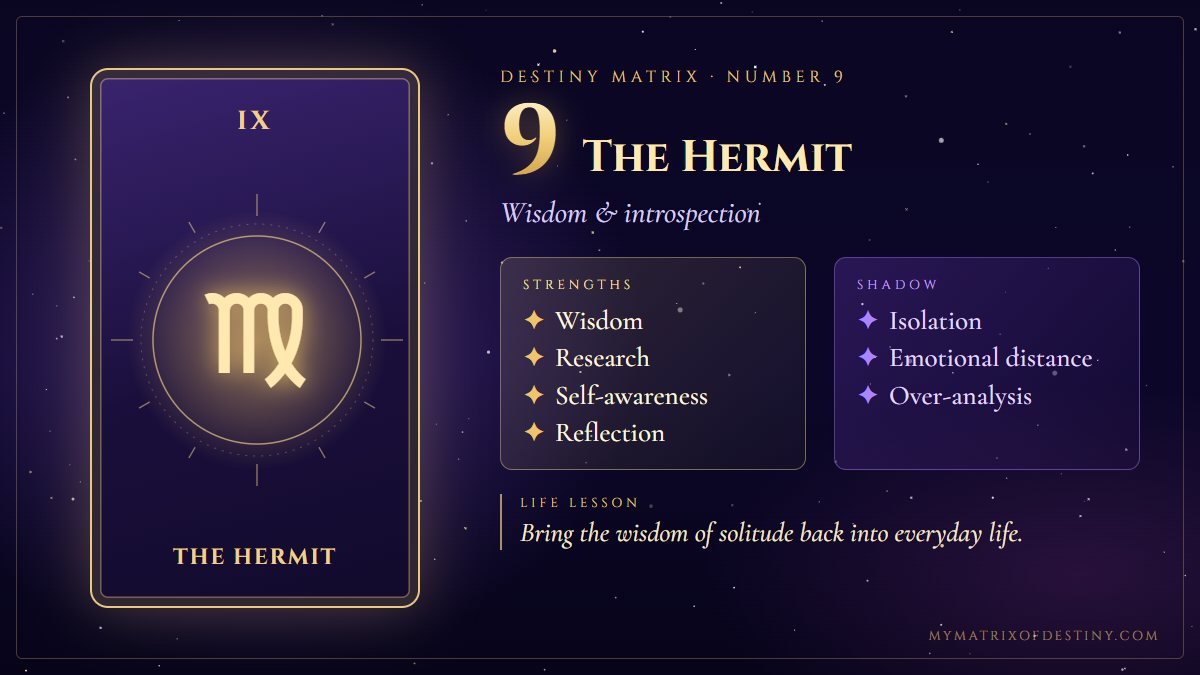
Core themes: wisdom, introspection, knowledge, solitude, inner guidance
The Hermit represents the search for deeper understanding.
This energy can encourage research, reflection, independent thought, and periods of solitude.
It does not necessarily mean loneliness. Healthy solitude can provide the space needed to understand yourself and your experiences.
Strengths
- Wisdom
- Research
- Self-awareness
- Independent thinking
- Reflection
- Patience
- Spiritual exploration
Shadow expression
The challenging side can include isolation, emotional distance, excessive analysis, or avoiding connection with others.
Life lesson
Solitude can lead to wisdom, but wisdom also needs to be brought back into everyday life.
Number 10 — Wheel of Fortune
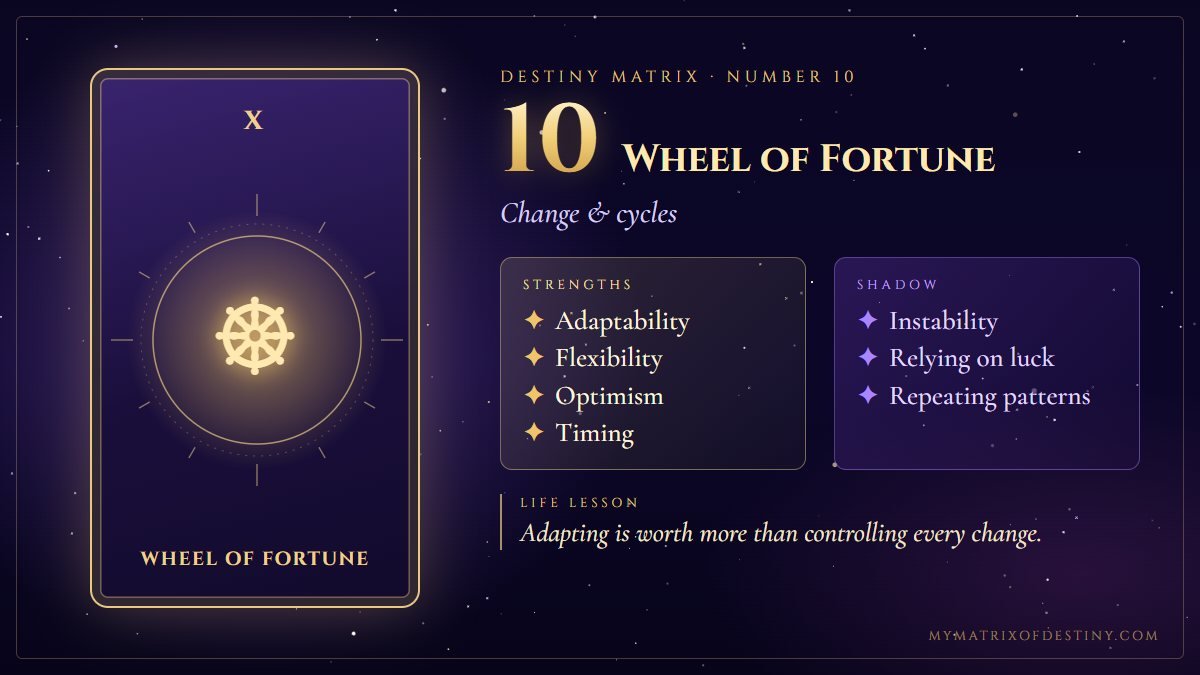
Core themes: change, cycles, opportunity, timing, adaptability
Wheel of Fortune represents movement and changing circumstances.
Its symbolism reminds us that life is not always linear. Opportunities can appear unexpectedly, and circumstances can change. A Destiny Matrix year forecast can help you see which cycle you are currently in.
Strengths
- Adaptability
- Flexibility
- Optimism
- Opportunity recognition
- Timing
- Ability to handle change
Shadow expression
Its difficult side can involve instability, relying too heavily on luck, resisting uncertainty, or repeatedly falling into familiar patterns.
Life lesson
Learning to adapt can be more valuable than trying to control every change.
Number 11 — Strength
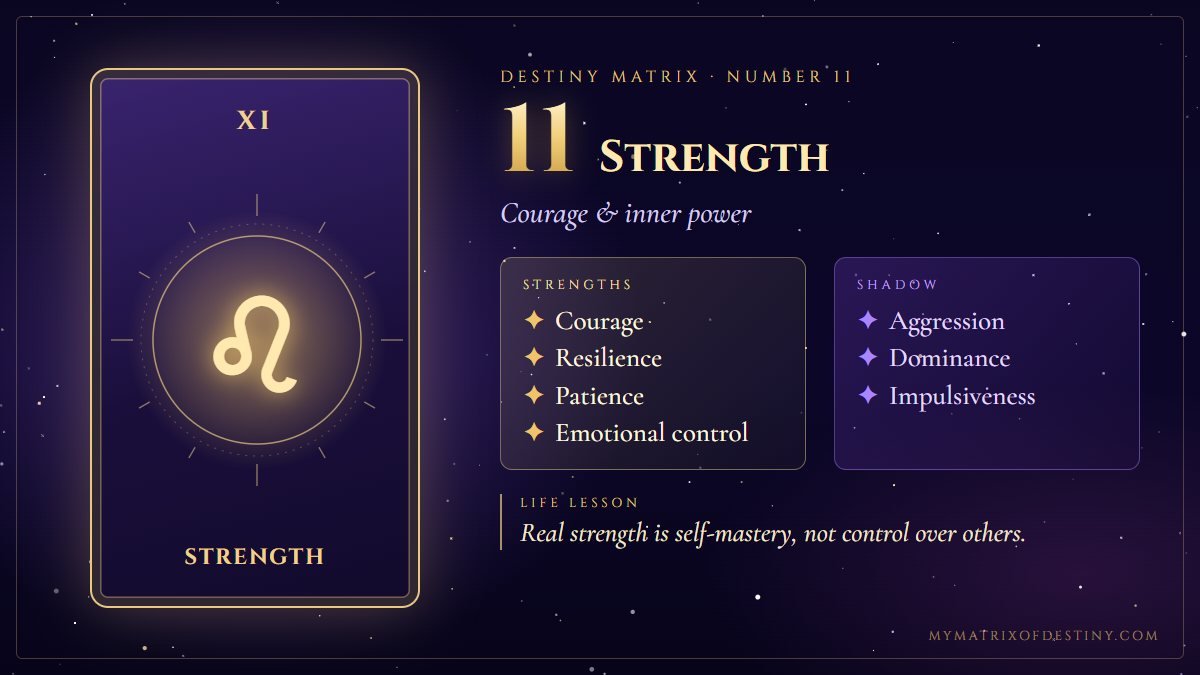
Core themes: courage, resilience, confidence, patience, self-control
Strength represents inner power rather than force.
It is associated with courage, emotional regulation, patience, resilience, and the ability to remain steady under pressure.
Strengths
- Courage
- Confidence
- Resilience
- Patience
- Emotional control
- Determination
- Leadership
Shadow expression
Unbalanced expression can become aggression, dominance, anger, impulsiveness, or the need to prove one's strength.
Life lesson
Real strength is often demonstrated through self-mastery rather than control over others.
Number 12 — The Hanged Man
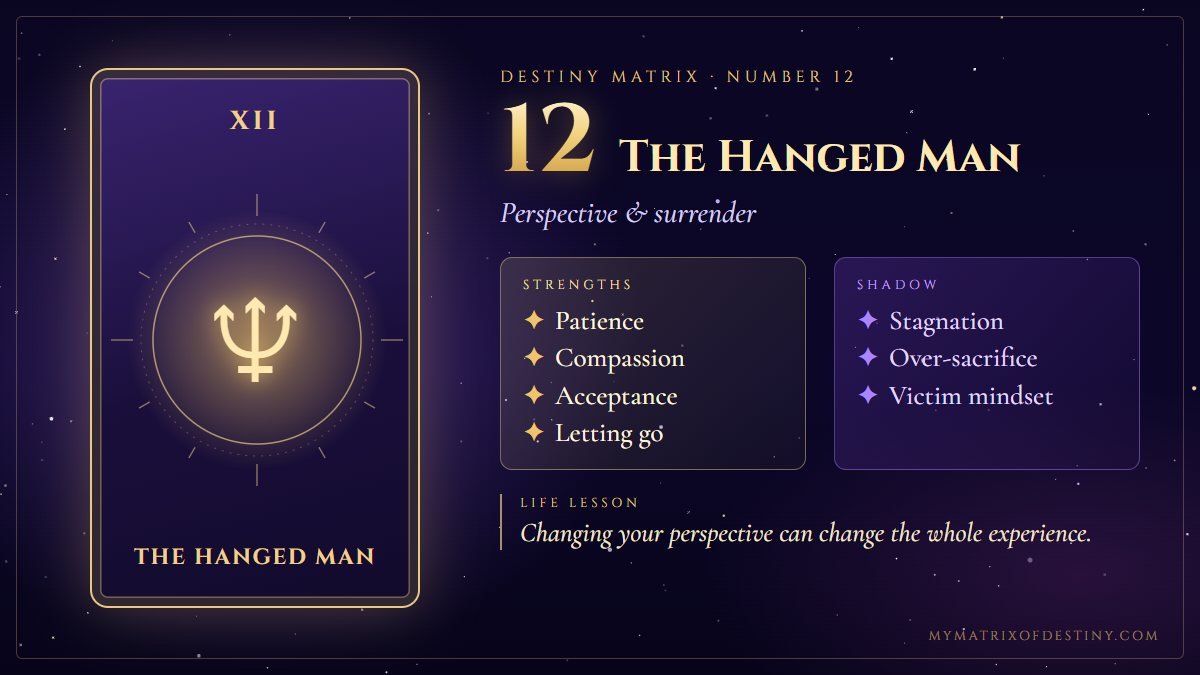
Core themes: patience, surrender, perspective, acceptance, sacrifice
The Hanged Man represents a pause and a change in perspective.
Sometimes progress does not come from pushing harder. It may come from stepping back and seeing a situation differently.
Strengths
- Patience
- Compassion
- Reflection
- Acceptance
- Perspective
- Letting go
- Spiritual insight
Shadow expression
Challenges may include stagnation, excessive sacrifice, indecision, or seeing yourself primarily as a victim of circumstances.
Life lesson
Not every situation needs to be forced. Sometimes changing your perspective changes the entire experience.
Number 13 — Death
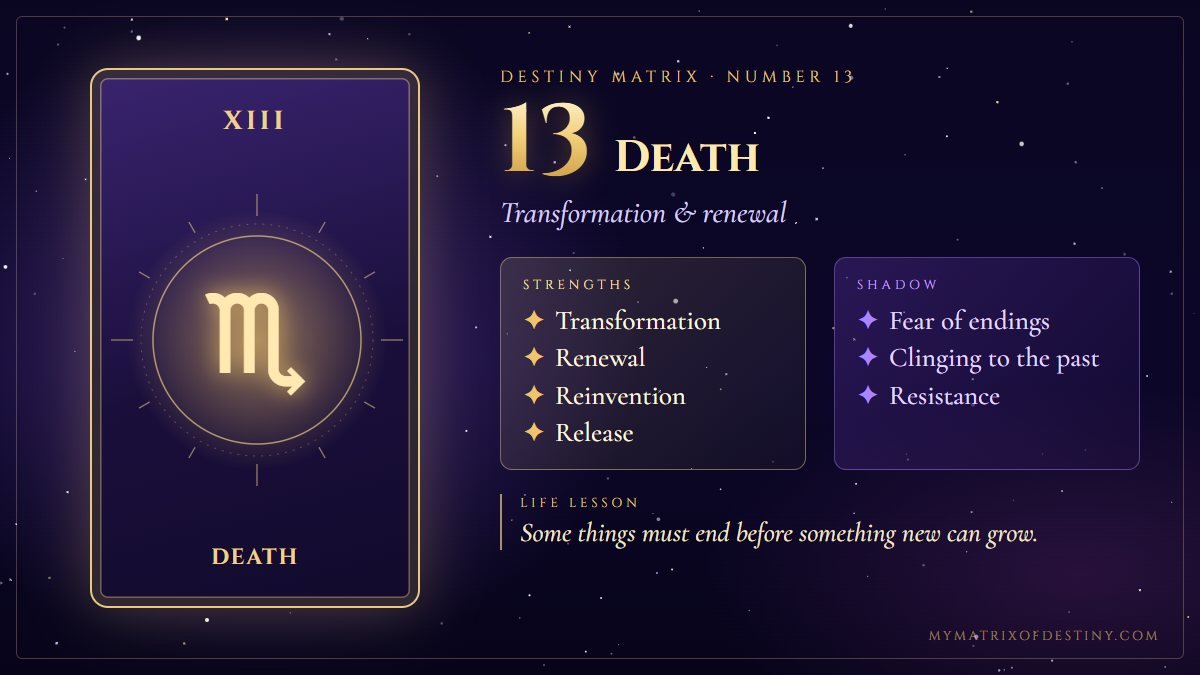
Core themes: transformation, endings, renewal, release, rebirth
The thirteenth energy corresponds with Death, but its symbolic meaning should not automatically be interpreted literally.
Within the archetypal framework, it is primarily about transformation.
It represents the end of one stage and the possibility of entering another.
Strengths
- Transformation
- Renewal
- Adaptability
- Personal growth
- Release
- Reinvention
- Acceptance of change
Shadow expression
Fear of endings, attachment to the past, resistance, and destructive reactions to change can represent its difficult side.
Life lesson
Some things need to end before something new can develop.
Number 14 — Temperance
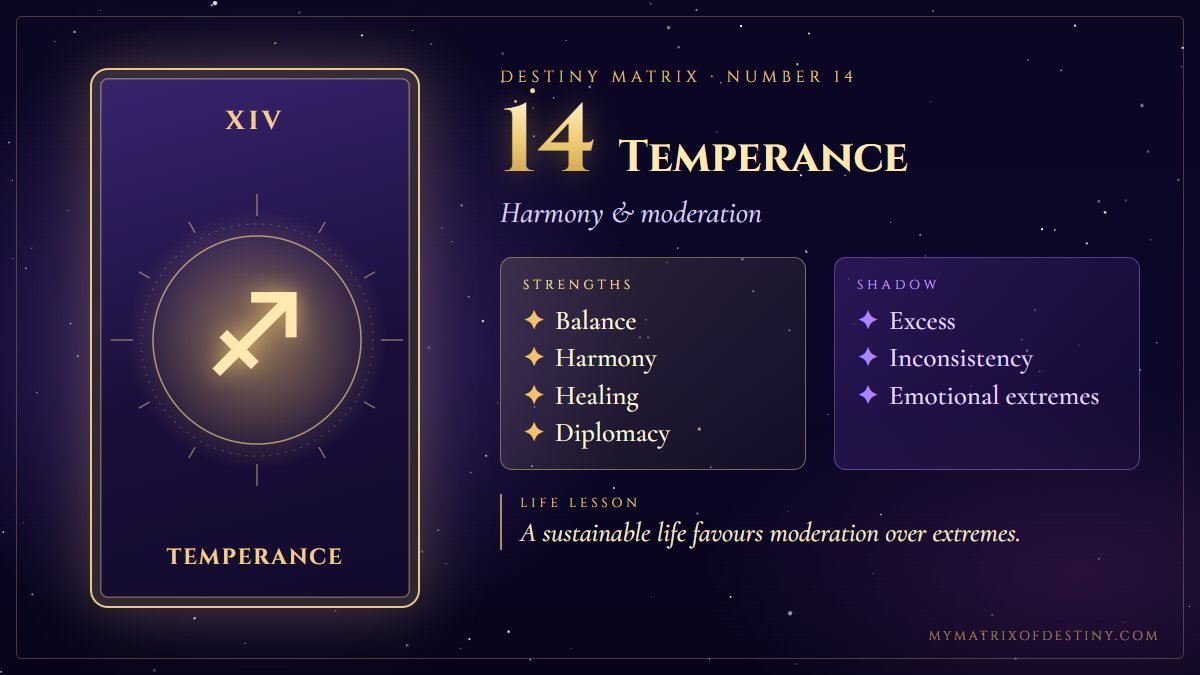
Core themes: harmony, balance, healing, patience, moderation
Temperance represents integration.
It is about finding a workable middle ground rather than constantly moving between extremes.
Strengths
- Balance
- Patience
- Harmony
- Healing
- Diplomacy
- Adaptability
- Moderation
Shadow expression
Its difficult side may appear as excess, inconsistency, emotional extremes, impatience, or difficulty maintaining healthy boundaries.
Life lesson
A sustainable life usually requires moderation rather than extremes.
Number 15 — The Devil
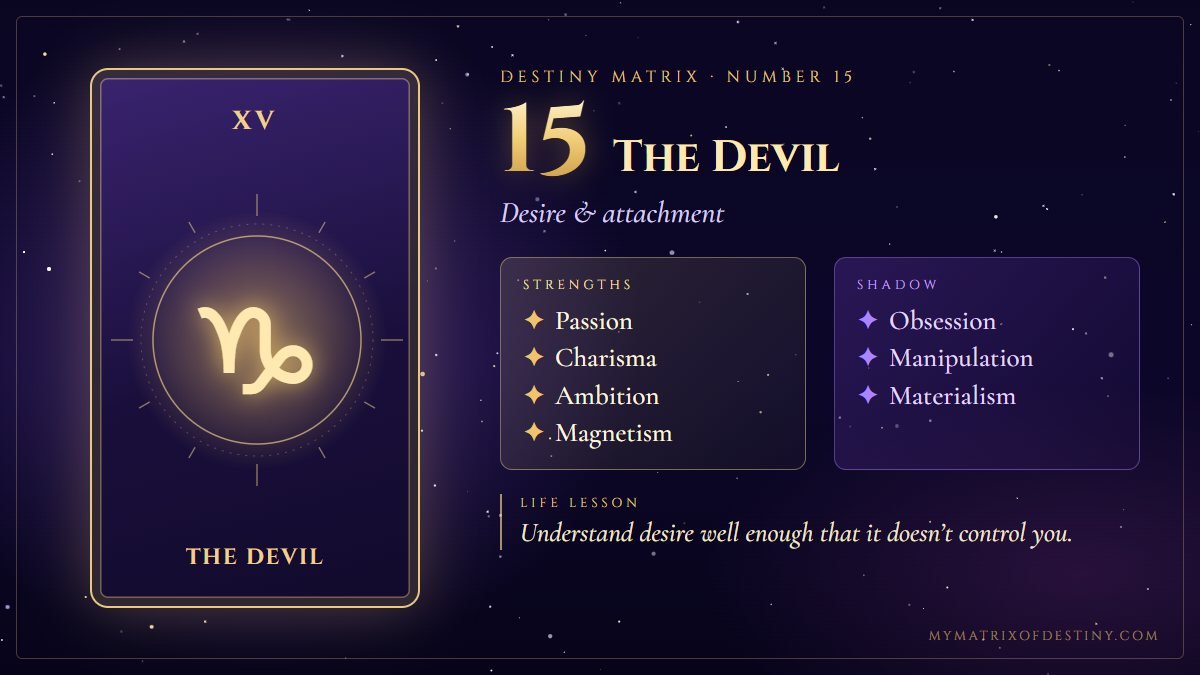
Core themes: desire, passion, attachment, ambition, temptation
The Devil is one of the most misunderstood archetypes.
Rather than simply representing something negative, it can point toward powerful desires, ambition, attraction, material goals, and the things that have the strongest hold over us.
Strengths
- Passion
- Charisma
- Ambition
- Strong motivation
- Creativity
- Material drive
- Personal magnetism
Shadow expression
Possible difficulties include obsession, addiction, jealousy, manipulation, excessive materialism, and becoming controlled by desires.
Life lesson
The goal is not necessarily to eliminate desire, but to understand it well enough that it does not control you.
Number 16 — The Tower
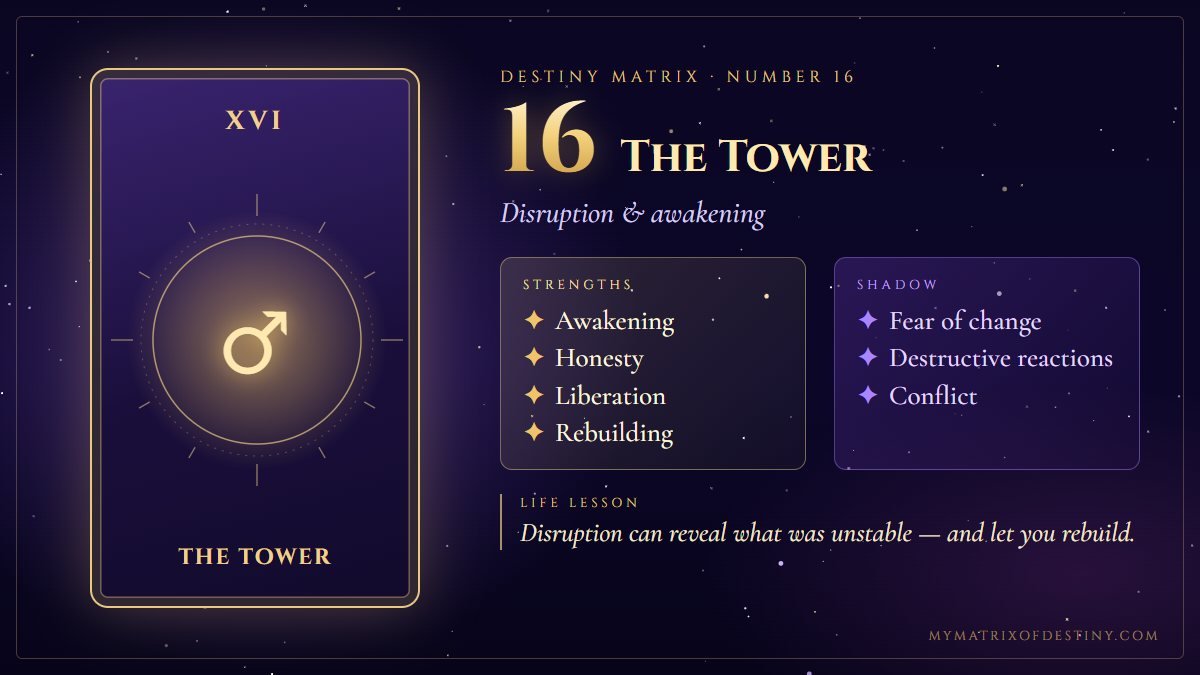
Core themes: disruption, awakening, revelation, rebuilding, sudden change
The Tower represents the collapse of structures that can no longer support us.
This can be uncomfortable, but its symbolism can also represent liberation from outdated beliefs, habits, or situations.
Strengths
- Awakening
- Honesty
- Liberation
- Rebuilding
- Courage
- Transformation
- Breaking unhealthy patterns
Shadow expression
Fear of change, destructive reactions, resistance, conflict, and attachment to unstable structures may represent its difficult expression.
Life lesson
A major disruption can sometimes reveal what was already unstable and create an opportunity to rebuild differently.
Number 17 — The Star
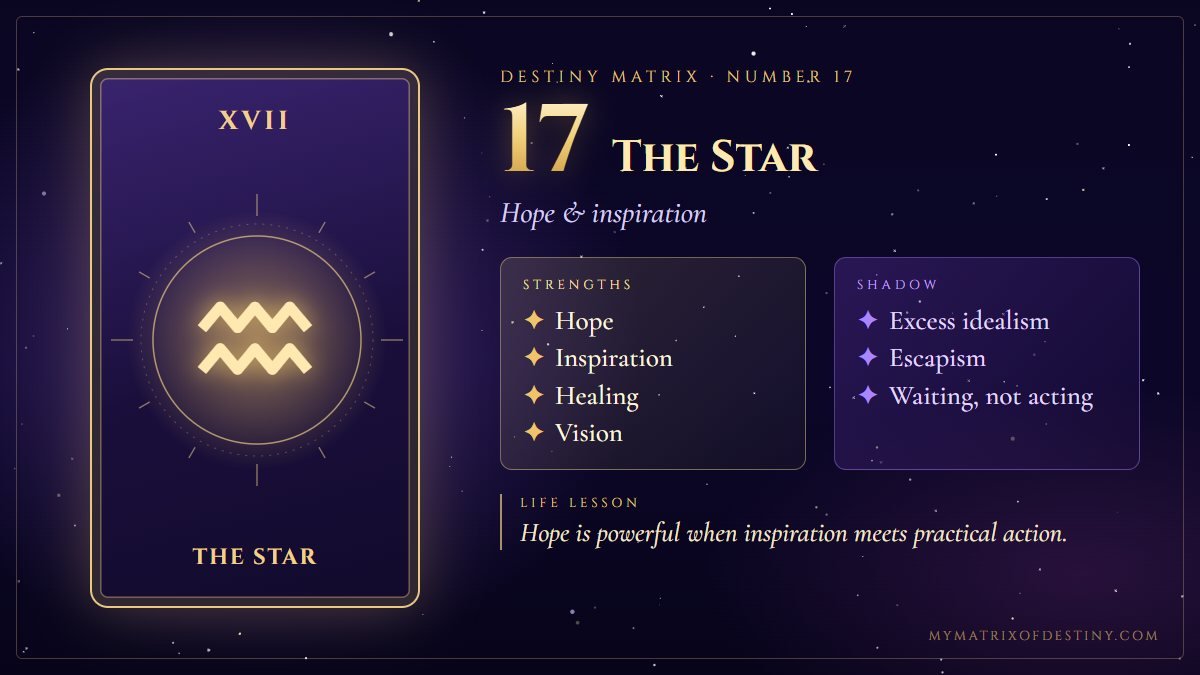
Core themes: hope, inspiration, creativity, healing, vision
The Star represents hope and a renewed sense of direction.
It can be associated with imagination, inspiration, faith, creativity, and the belief that improvement is possible.
Strengths
- Hope
- Inspiration
- Creativity
- Optimism
- Healing
- Vision
- Generosity
Shadow expression
Excessive idealism, unrealistic expectations, escapism, or waiting for circumstances to change without taking action can become challenges.
Life lesson
Hope becomes powerful when inspiration is combined with practical action.
Number 18 — The Moon
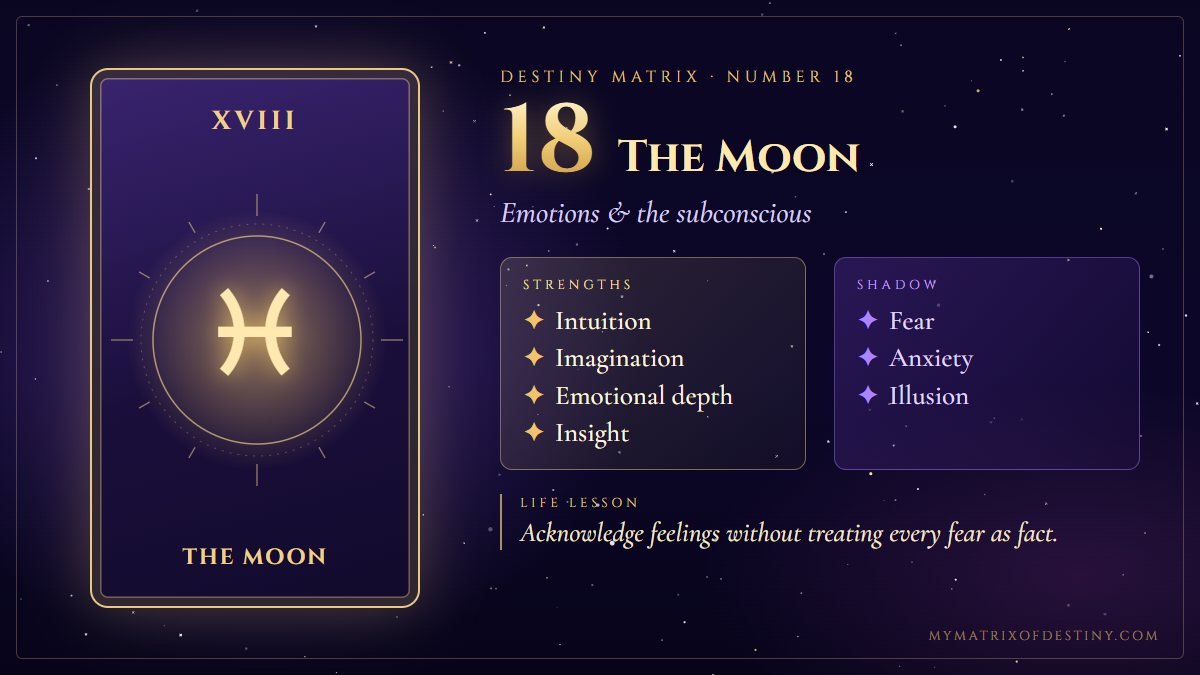
Core themes: emotions, intuition, dreams, imagination, subconscious patterns
The Moon represents the less visible aspects of experience: dreams, emotions, imagination, fears, instincts, and subconscious patterns.
This can create a rich inner world, but it can also make it difficult to distinguish intuition from anxiety.
Strengths
- Intuition
- Imagination
- Creativity
- Emotional depth
- Sensitivity
- Dream awareness
- Psychological insight
Shadow expression
Fear, confusion, emotional instability, illusion, anxiety, and overthinking may appear when this energy becomes unbalanced.
Life lesson
Emotional awareness becomes stronger when feelings are acknowledged without automatically treating every fear as a fact.
Number 19 — The Sun
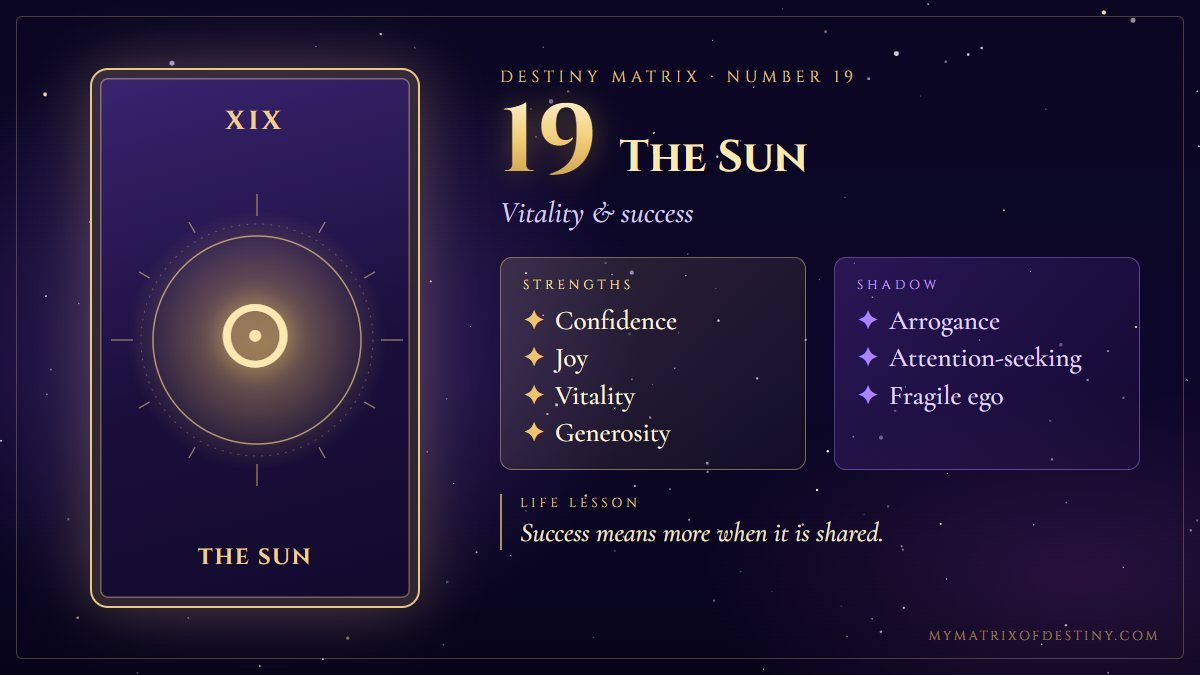
Core themes: joy, confidence, success, recognition, vitality, visibility
The Sun represents warmth, openness, confidence, and achievement.
This energy can be associated with people who enjoy expressing themselves openly and sharing their abilities with others.
Strengths
- Confidence
- Happiness
- Success
- Creativity
- Recognition
- Vitality
- Generosity
- Optimism
Shadow expression
Too much emphasis on recognition can become arrogance, ego, attention-seeking, or difficulty accepting criticism.
Life lesson
Confidence becomes more meaningful when success is shared rather than used only for personal validation.
Number 20 — Judgement
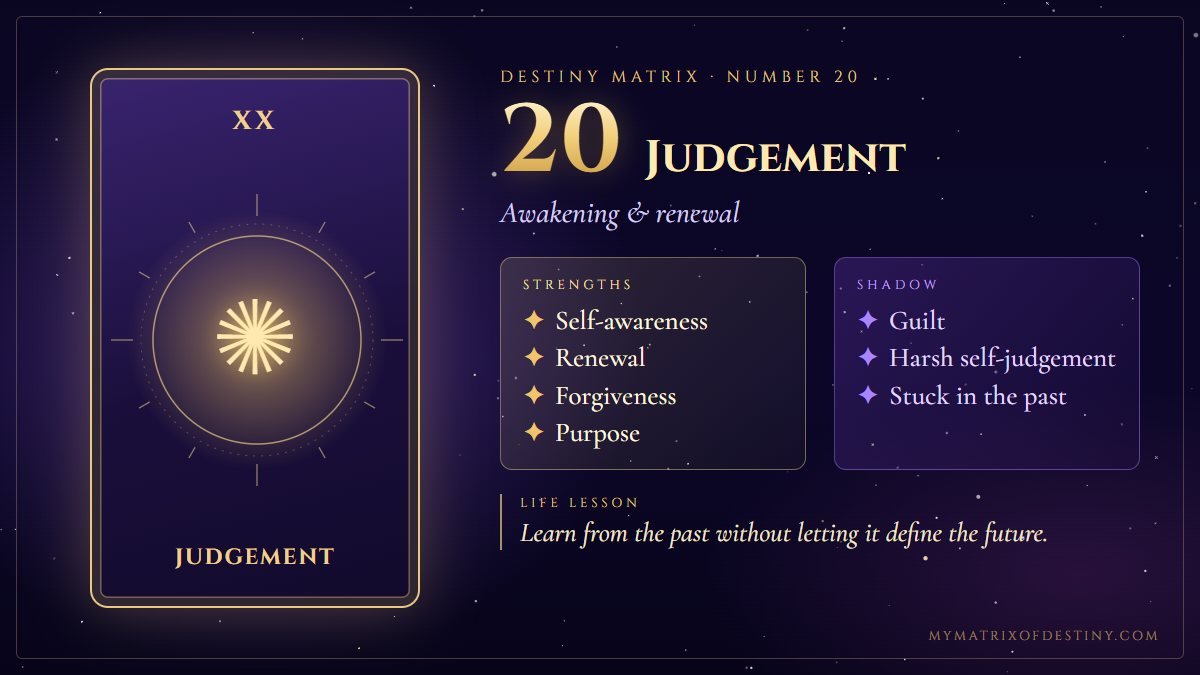
Core themes: awakening, renewal, reflection, accountability, calling
Judgement represents a moment of recognition and awakening.
It can symbolize reviewing the past, understanding what has been learned, and making a conscious decision about what comes next.
Strengths
- Self-awareness
- Renewal
- Accountability
- Forgiveness
- Reflection
- Transformation
- Sense of purpose
Shadow expression
Guilt, harsh self-judgement, judging others, or remaining trapped in past mistakes can become obstacles.
Life lesson
Growth requires learning from the past without allowing it to permanently define the future.
Number 21 — The World
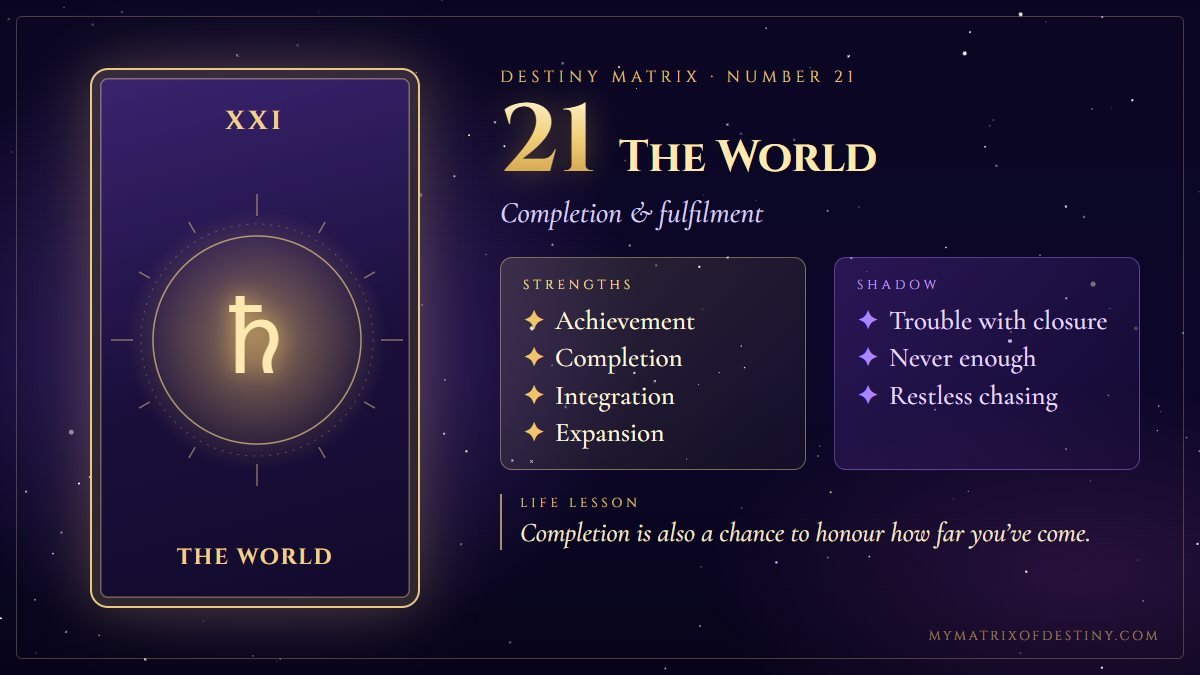
Core themes: completion, achievement, fulfilment, integration, expansion
The World represents the completion of a cycle.
It can symbolize reaching an important milestone, integrating previous lessons, and recognizing the journey as a whole.
Strengths
- Achievement
- Completion
- Fulfilment
- Integration
- Success
- Expansion
- Recognition
Shadow expression
A person may struggle with closure, constantly pursue the next goal, or feel that an achievement is never enough.
Life lesson
Completion is not the end of growth. It is also an opportunity to recognize what has already been accomplished.
Number 22 — The Fool
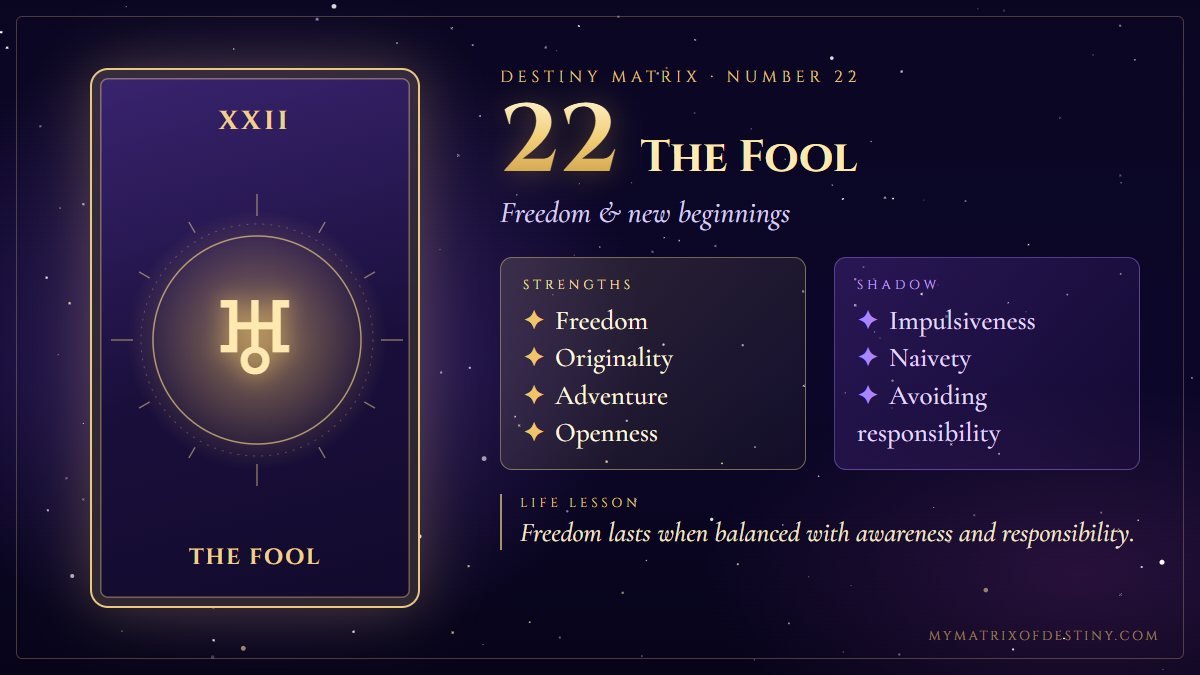
Core themes: freedom, adventure, originality, spontaneity, new beginnings
The Fool represents the beginning of a new journey.
This energy is associated with openness, curiosity, freedom, experimentation, and the willingness to step into unfamiliar territory.
Strengths
- Freedom
- Originality
- Adventure
- Creativity
- Flexibility
- Optimism
- Openness to new experiences
Shadow expression
Impulsiveness, irresponsibility, naivety, lack of direction, and avoidance of responsibility can become challenges.
Life lesson
Freedom becomes more sustainable when it is balanced with awareness and responsibility.
How Position Changes the Meaning
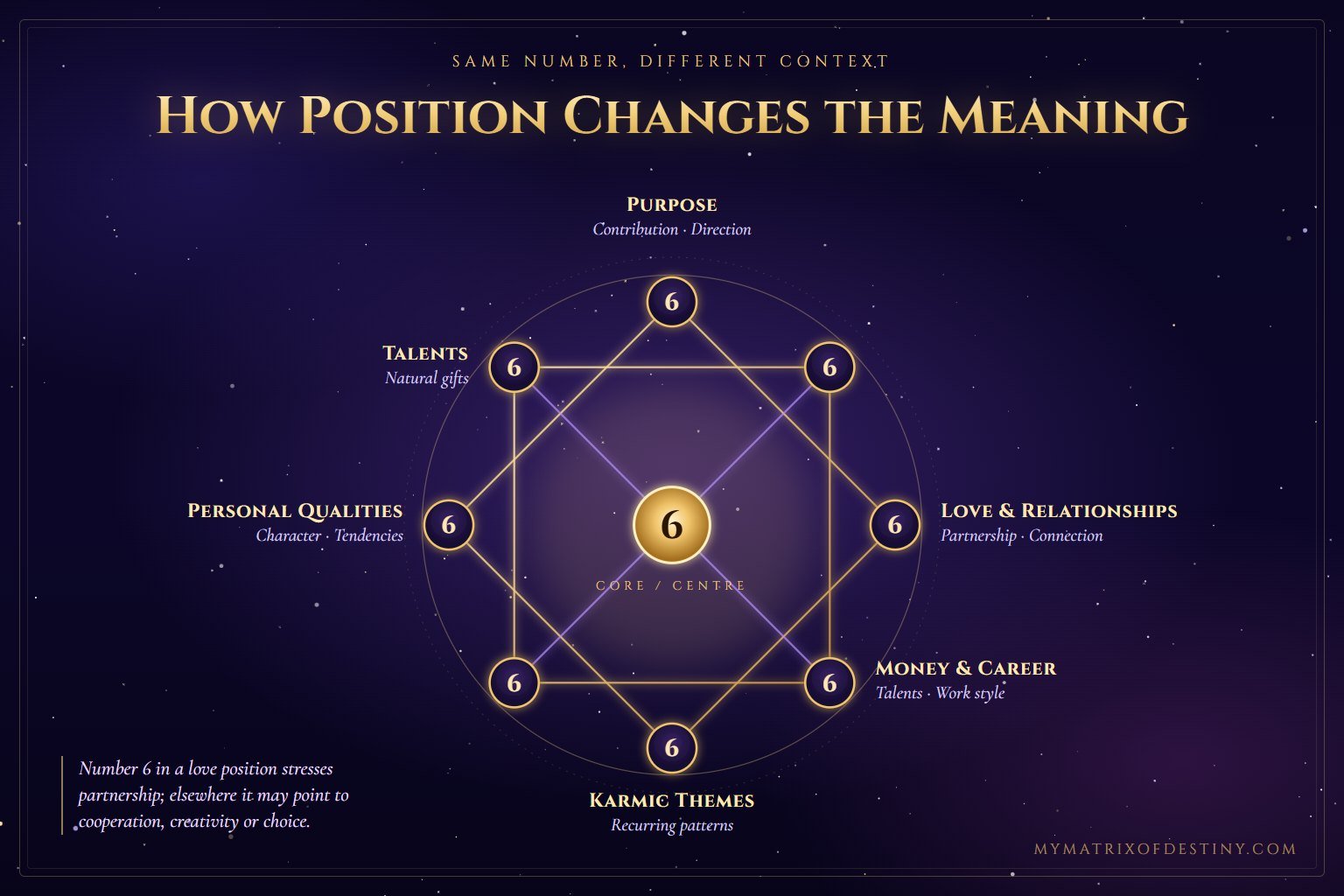
One of the biggest mistakes beginners make is assuming that a number always has one fixed interpretation.
In a complete chart, position matters.
A particular energy might appear in a position associated with relationships, while the same one elsewhere could relate to money, personal qualities, purpose, or another aspect of life.
For example, Number 6 in a relationship-related position may emphasize partnership and emotional connection. The same energy in a different position may point more toward cooperation, creativity, or decision-making.
This is why reading an individual number alone gives only part of the picture.
The Core or Center
The central area is often interpreted as an important part of a person's fundamental energetic pattern.
It can be used to explore themes such as:
- Character
- Natural tendencies
- Personal strengths
- Internal motivations
- Areas requiring development
Relationships and Love
Relationship-related positions can provide a symbolic way to explore (you can compare two charts with the free compatibility calculator):
- Emotional patterns
- Partnership
- Attraction
- Communication
- Compatibility
- Relationship challenges
- Expectations in love
Money and Career
Financial or professional positions may be interpreted through themes such as:
- Talents
- Work style
- Business tendencies
- Material goals
- Professional strengths
- Financial habits
It is important not to interpret these positions as guarantees of wealth or financial success.
Life Purpose
Purpose-related areas can be used to explore broader questions about:
- Contribution
- Personal development
- Meaning
- Talents
- Service
- Direction
- Long-term growth
Karmic Themes
Some Destiny Matrix interpretations also use concepts such as a karmic tail or karmic lessons.
These should be understood symbolically rather than as proof that a person is being punished for something from a previous life.
They can instead be used as prompts for examining recurring patterns, challenges, and areas where greater awareness may be helpful. You can find yours with the karmic tail calculator.
Positive and Shadow Expressions
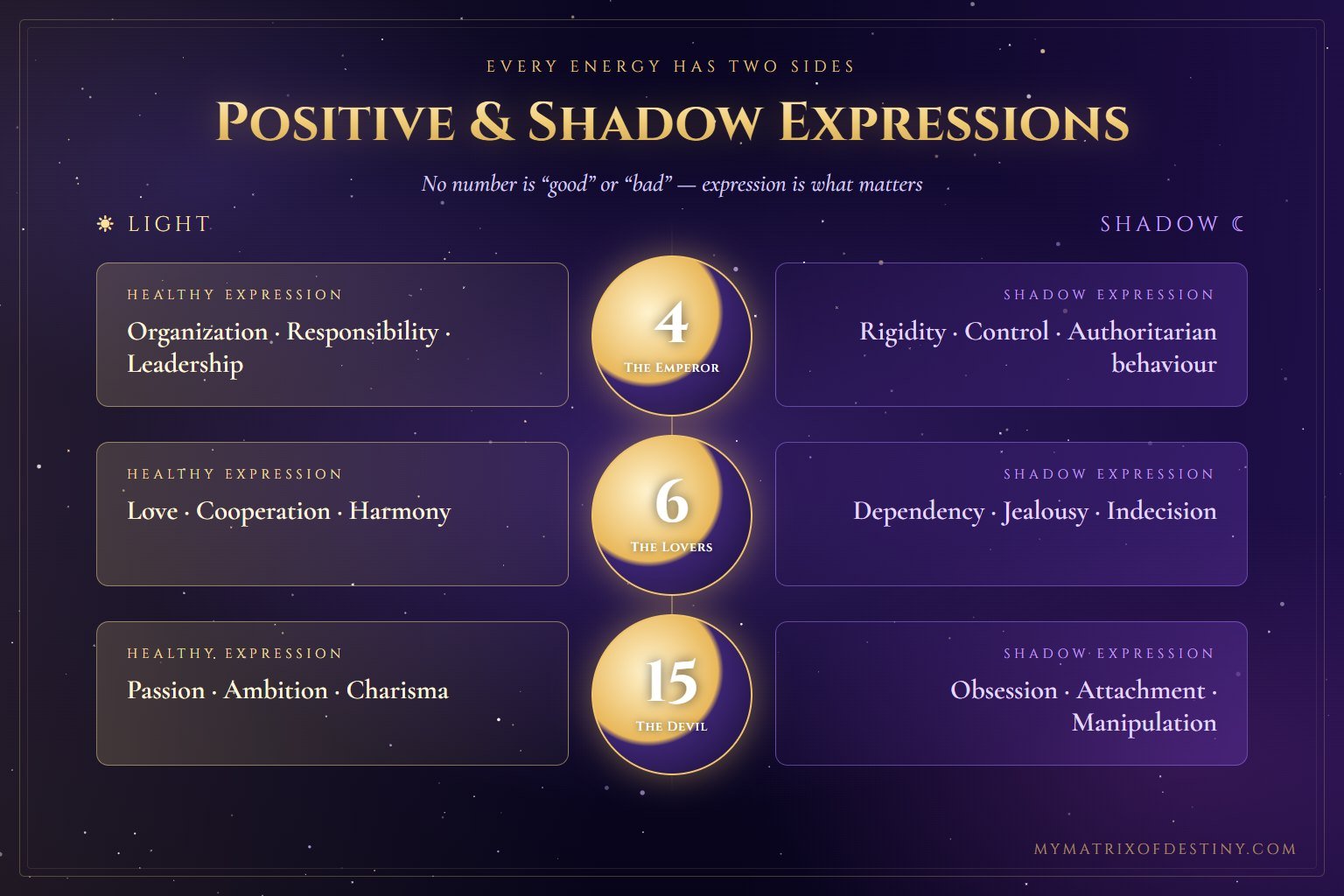
A useful way to understand this system is to think in terms of expression rather than fixed personality labels.
For example:
Number 4
- Healthy expression → organization, responsibility, leadership
- Shadow expression → rigidity, control, authoritarian behaviour
Number 6
- Healthy expression → love, cooperation, harmony
- Shadow expression → dependency, jealousy, indecision
Number 15
- Healthy expression → passion, ambition, charisma
- Shadow expression → obsession, attachment, manipulation
This approach makes the system more nuanced.
A challenging expression does not mean that someone is destined to behave negatively. It simply represents a possible pattern to become aware of.
How to Interpret Your Own Numbers
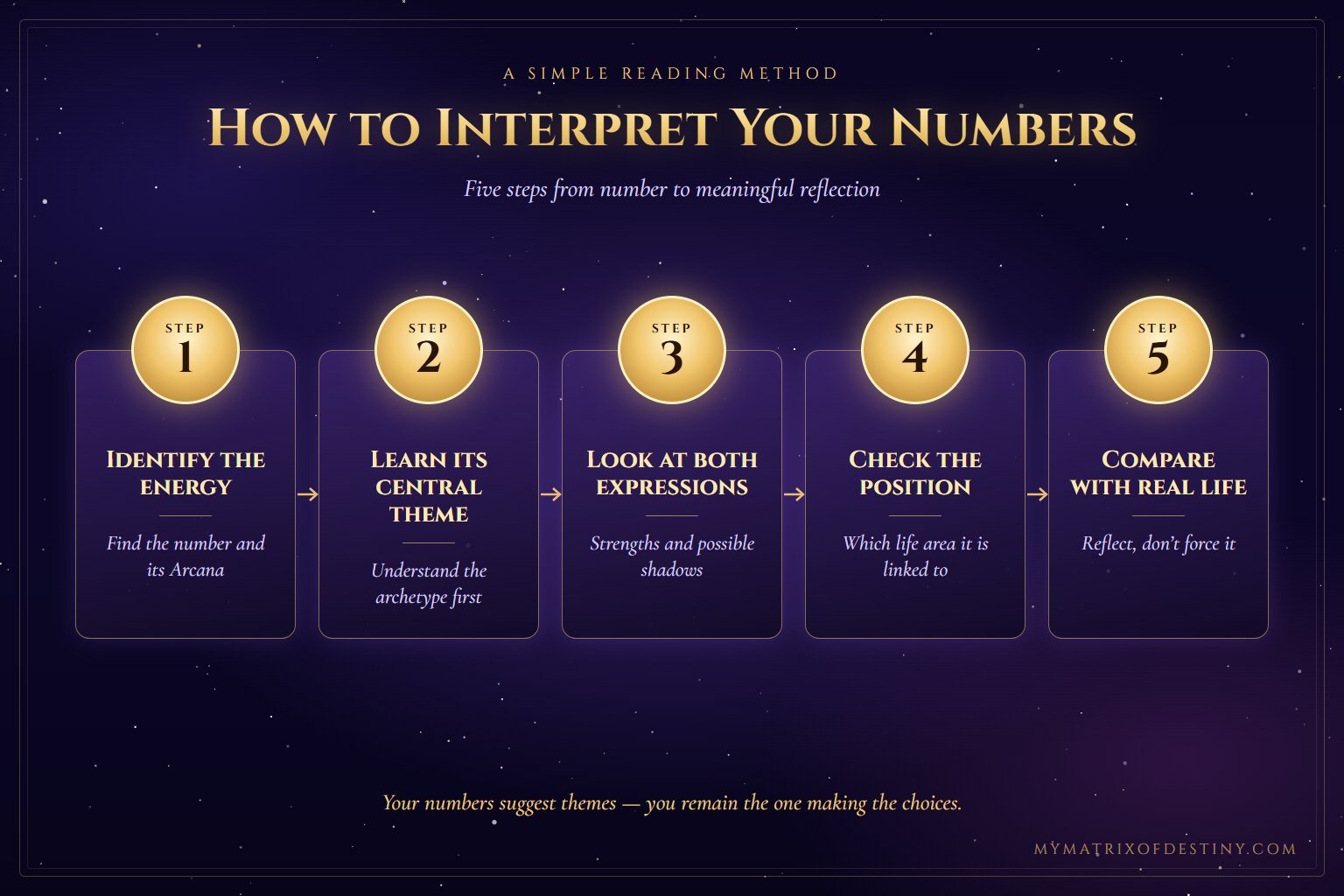
If you have generated your chart, you can begin with a simple five-step approach.
Step 1: Identify the energy
Find the number and its corresponding Arcana.
Step 2: Learn its central theme
Understand what the archetype represents before jumping into detailed interpretations.
Step 3: Look at both expressions
Consider both the constructive qualities and possible challenges.
Step 4: Check the position
Ask which area of life the number is connected with in your chart.
Step 5: Compare it with your real experience
The most useful interpretation is one that encourages thoughtful reflection rather than forcing every event in your life to fit a predetermined description.
Destiny Matrix and Traditional Numerology: Are They the Same?
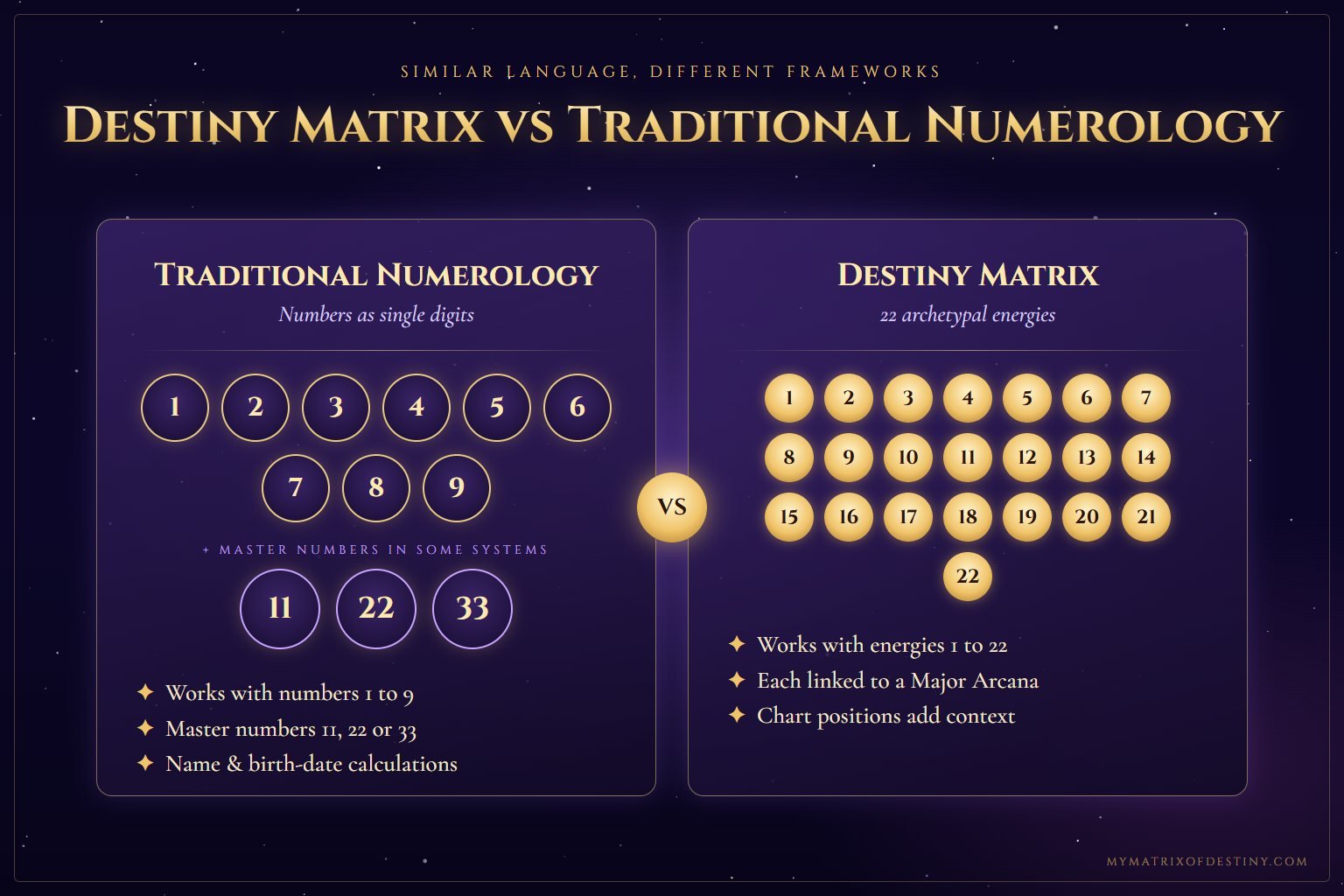
No.
Although both approaches use numbers as symbolic tools, they are based on different frameworks.
Traditional numerology commonly works with numbers from 1 to 9, with some systems also using master numbers such as 11, 22, or 33.
The Destiny Matrix generally works with 22 archetypal energies associated with the Major Arcana.
Because of this, the two systems may use similar language around personality, purpose, and life patterns while approaching those subjects differently.
Final Thoughts
The 22 energies offer a broad symbolic vocabulary for exploring different dimensions of human experience.
From The Magician's initiative and The High Priestess's intuition to The World's sense of completion and The Fool's willingness to begin again, every archetype brings both opportunities and challenges.
The most useful way to approach a chart is therefore not to search for a single "best" number.
Instead, ask:
- What does this energy represent?
- How can I express its strengths?
- Where might its shadow appear?
- What does its position tell me?
- How does this symbolism relate to my actual experiences?
Used in this way, the Destiny Matrix can become a structured tool for reflection and self-exploration rather than a rigid description of who you are or what will happen to you.
Your numbers may provide themes to consider, but you remain the person making the choices that shape your life.
Ready to see which energies appear in your own chart? Calculate your free Destiny Matrix or look up a single number with the Arcana Calculator.
Frequently Asked Questions
Common questions about this topic answered concisely.
Continue your journey
Discover your Destiny Matrix
Calculate your chart, check compatibility, and explore your karmic energies with the free tools.
Destiny Matrix Team
Numerology Writer
A specialist in numerology and destiny matrix interpretation, helping readers understand karmic patterns and archetypal energies.